




Country Jeep Oxford – Which is better for daily driving and weekend trails around Newark, DE — the 2026 Jeep Wrangler or the 2026 Ford Bronco?
If you’re cross-shopping the 2026 Jeep® Wrangler and the 2026 Ford Bronco® around Newark, DE, you’re probably asking a deceptively simple question: which one is easier to live with during the week and more confident on the trails come Saturday? Both are legitimate off-road machines with removable doors and roof options, stout drivetrains, and modern tech. But if you look closely at the fundamentals—axles, low range gearing, towing confidence, and how well driver-assistance tech coexists with trail armor—the Wrangler grabs a quiet but decisive lead.
Start with the chassis. Wrangler’s solid front and rear axles excel when trails get uneven and rutted. Solid axles allow the left and right wheels to articulate more predictably and stay in contact over offset rocks and washouts. That means more traction, less wheelspin, and calmer body motions right when you’re trying to place a tire on a ledge. Bronco uses an independent front suspension that can be smoother on high-speed washboard, but it can’t match the Wrangler’s articulation in slow, technical sections common on the access paths and creekside cut-throughs west of Newark. That slow-speed control also shows up in gearing: the Wrangler’s available Rock-Trac® 4×4 system with a 4:1 low range and available 4.88:1 axle ratio delivers a 100:1 crawl ratio with the manual transmission. Bronco counters with a crawler gear and locking differentials, which are genuinely helpful, but its overall crawl ratio trails the Wrangler when you compare like-for-like setups.
Weekday drivability that feels normal, not niche
Daily driving matters too. Wrangler has steadily refined on-road manners without diluting its trail DNA. The steering feels direct, the ride is composed, and the cabin packs an intuitive, standard 12.3-inch Uconnect® 5 touchscreen with fast responses, clear navigation, and seamless smartphone integration. Commuting on DE-896 or hopping across the I-95 corridor is simple, and the Wrangler’s tall seating position gives you clear sightlines in traffic and at tricky parking lot angles. Bronco’s cabin technology is strong as well, and Ford’s connected features are easy to like. The distinction is how effortlessly Wrangler toggles from weekday to weekend. Quick-release, no-tool door hinges and the available Sky One-Touch® Power Top transform your drive at a moment’s notice. With Bronco, the doors are removable and top choices are solid, but there’s no power-retractable roof option.
Towing and trail gear without compromises
When it’s time to tow a compact camper to Lums Pond or a small trailer for mountain bikes and kayaks, Wrangler 4-door models can be rated up to 5,000 pounds when properly equipped, while Bronco tops out at 4,500 pounds. The difference is real when you’re deciding which gear can come along. Wrangler’s smart sensor packaging also matters: Jeep places forward radar above the rearview mirror, freeing the front bumper area for serious trail kit. That design enables an available factory-installed WARN winch and available steel front bumper without compromising forward driver-assistance features. With Bronco, you’ll often be choosing between certain bumper-mounted tech and robust front-end accessories or relying on dealer-installed solutions to make it all work together.
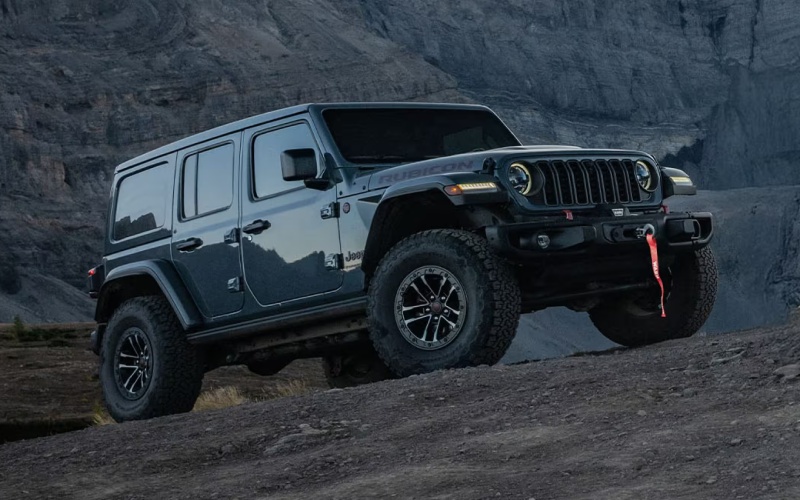
Off-road geometry is another decisive data point. The 2026 Jeep Wrangler 4-door posts a Best-in-Class available approach angle of up to 47.4 degrees, helping you clear steeper entries without bumper drama. Bronco posts strong figures, but Wrangler’s numbers and the way it uses them—short overhangs, immediate throttle control at idle, and predictable axle movement—make it particularly composed in Newark-area terrain where rock shelves and rain-cut ruts can show up without warning.
What about comfort and tech on longer drives?
Both SUVs have grown more comfortable. Wrangler offers available heated front seats and steering wheel, robust climate control, and cabin quietness that continues to improve with every generation. The 12.3-inch Uconnect 5 system pulls double duty, with off-road pages and trail metrics as well as the daily conveniences you expect—wireless smartphone integration, fast app loading, and optional built-in navigation. Bronco’s tech suite is competitive and intuitive, especially for drivers who prefer Google-based services. But Wrangler’s standard large display and trail-first menus make it easier to track what matters when the asphalt fades away.
- Axle design: Wrangler uses solid front and rear axles for superior articulation and traction over offset obstacles; Bronco uses independent front suspension that’s smoother at speed but less composed in technical crawling.
- Crawl ratio: Wrangler offers an available 100:1 crawl ratio (manual) for precise throttle control; Bronco’s crawler setup is helpful but doesn’t match Wrangler’s peak ratio.
- Towing confidence: Wrangler 4-door can be rated to 5,000 pounds when properly equipped; Bronco maxes out at 4,500 pounds.
- Open-air ease: Wrangler’s no-tool quick-release door hinges and available Sky One-Touch Power Top make going open-air a 10-second decision; Bronco lacks a power-retractable roof.
- Accessory integration: Wrangler’s forward radar sits above the mirror, keeping room for an available factory-installed WARN winch and steel front bumper; Bronco solutions typically rely on dealer-installed kits.
- Everyday tech: Wrangler’s standard 12.3-inch Uconnect 5 touchscreen is fast and intuitive; Bronco’s tech is strong, but display standards vary by trim.
So which one should you choose? If your Newark weekdays are a mix of town errands and commuting, and your weekends include slower, more technical trails, stream crossings where permitted, and some towing, the 2026 Jeep Wrangler is the more versatile pick. It’s not just about badges or marketing messages. It’s about a foundation—solid axles, real low-range gearing, geometry, and a cabin designed around both the daily grind and getting off the grid—that suits this region’s mix of paved, unpaved, and unimproved routes.
Frequently Asked Questions:
Can I get a manual transmission on both SUVs?
Yes. Wrangler offers a manual on key trims with the 3.6L Pentastar V6, and Bronco offers a 7-speed manual with its 2.3L EcoBoost I-4 on select trims.
Which one is quieter on the highway?
Both have made strides in cabin refinement. Wrangler’s latest sound insulation and roof options keep wind and tire noise in check, and Bronco performs similarly. Tire choice, gearing, and roof configuration will have an impact on either model.
Which is better for high-speed desert running?
Bronco showcases impressive high-speed control with its HOSS systems, and the Bronco Raptor specializes in that mission. Wrangler’s strength is crawling, precise slow-speed control, and versatile accessory integration.
Which has stronger low-speed crawling capability?
Wrangler. With Rock-Trac 4×4, a 4:1 low range, available 4.88:1 axle ratio, and manual transmission, it hits a 100:1 crawl ratio and pairs that with solid-axle articulation.
How about towing a small camper?
Wrangler 4-door can be rated to tow up to 5,000 pounds when properly equipped, while Bronco tops out at 4,500 pounds. If your camper, jet skis, or a lightweight boat are part of your plans, Wrangler offers extra margin.
If you’d like to explore builds side by side and dial in the right configuration, Country Chrysler Dodge Jeep RAM Oxford can help you compare trims, tow packages, axles, and roof systems in one visit. We’re proudly serving Downingtown, Newark, and Oxford with on-road test loops and nearby light-trail routes to give you a clear feel for both daily driving and weekend use. Bring your questions, your gear wish list, and your favorite routes—we’ll help you choose with confidence.
Request more 2026 Jeep Wrangler information
Connect with us

